
close

October 13, 2025

Business

Wood Window Repair and Glazing Services in Rockford, IL, 2025

Rockford’s older homes weren’t built to be disposable. In 2025, many owners are choosing to repair wood windows rather than rip them out, preserving character while tackling drafts, rattles, and rising energy bills. This guide walks through how skilled wood window repair and glazing restore function and beauty, why sealing and weatherization matter, and how to strike the right balance between historic details and modern performance. For anyone searching ” Window Glazing Rockford IL,” it frames what high‑quality work looks like now and what actually pays off in a northern Illinois climate.

Importance of preserving older wood windows in Rockford homes

Rockford boasts a proud collection of early 20th-century bungalows, foursquares, and Victorians—from Haight Village to long-established neighborhoods shaded by mature trees. Their wood windows are integral to each home’s architectural DNA. When these windows are repaired rather than replaced, the house retains its original character: slim sightlines, wavy-glass charm (when present), and hand-tooled joinery that modern factory units can’t quite replicate.

There’s a practical side, too. The old-growth lumber used in historic sashes is dense, stable, and remarkably durable when maintained properly. These windows were built to be serviceable—glazing and putty can be renewed, rails patched, and individual panes replaced without discarding the entire unit. Keeping them in use avoids landfill waste and preserves the embodied carbon already invested in the home.

Well-restored wood windows also help sustain property values. Appraisers and buyers appreciate authenticity, especially in historic districts where alterations are closely reviewed. With modern weatherstripping, storm window options, and precise reglazing, original wood windows can be quiet, smooth-operating, and energy-efficient enough for Rockford’s four distinct seasons.

For expert craftsmanship in wood window restoration, repair, and preservation, homeowners can trust Apex Window Werks—a leading specialist serving Rockford and the greater Chicagoland area.

Common repair needs: cracks, rot, and seal deterioration

Northern Illinois winters, hot summers, and freeze‑thaw cycles are tough on wood and glazing. The most common issues technicians see include:

  • Failing glazing putty: Dried, cracked, or missing putty leaves glass loose and lets water into the sash rabbet. That moisture starts the rot clock.
  • Sill and bottom‑rail rot: Standing water, worn paint, or clogged drip kerfs lead to soft spots along sills and lower rails. Catch it early and epoxy consolidation or Dutchman patches can save the original parts.
  • Hairline glass cracks: Small cracks can sometimes be stabilized short‑term, but most fractured panes are replaced for safety and clarity.
  • Stuck or drooping sashes: Broken sash cords, tired balances, and layers of paint can lock windows shut or make them slam. Restoring smooth travel is part mechanics, part tune‑up.
  • Air leaks and rattles: Gaps at the meeting rail, parting beads, or stops cause drafts and noise. These are classic weatherstripping opportunities.
  • Peeling paint and lead concerns: On pre‑1978 homes, lead‑safe work practices are essential. Professional crews follow EPA RRP rules, containment, HEPA cleanup, and safe disposal, to protect families and workers.

The good news: most of these issues are repairable without sacrificing historic fabric. A thoughtful assessment separates cosmetic problems from structural ones and prioritizes fixes for longevity.

Glazing techniques that restore strength and clarity

Window glazing is both craft and science. Done right, it anchors the glass, seals out weather, and creates that crisp, sloped profile around each pane.

A proven process

  • Careful removal: Technicians often remove the sash to a bench. Old putty is softened with an infrared heater or steam (gentler than a torch) to protect the wood and glass. Glazing points are lifted out, and panes are freed.
  • Prep the rabbet: After scraping, the wood is sanded and primed. A light coat of linseed oil or alkyd primer on bare wood keeps it from stealing oils from the new putty.
  • Bed the glass: A thin “bed” of putty is laid in the rabbet. The pane is pressed in so putty squeezes slightly, then metal glazing points are set every 6–8 inches to hold it tight.
  • Tool the face putty: A smooth, even bevel sheds water and looks right under paint. Sharp corners and consistent lines separate pro work from weekend attempts.
  • Prime and paint: Once cured to spec (traditional linseed putty cures slower than modern elastomeric compounds), the glaze line is primed and painted, overlapping the glass by a hair to form a weatherproof seal.

Material choices in 2025

Homeowners can stick with traditional linseed putty for authenticity or choose high‑performance, paintable elastomeric glazing compounds for faster return‑to‑service. Glass options range from standard clear to low‑iron for extra clarity, or restoration glass to preserve a period‑correct look. Silicone is great in many places but typically avoided on paintable glazing lines because it resists coatings.

For anyone searching Window Glazing Rockford IL, those steps and materials are the hallmarks of a job that lasts, resists water, and keeps panes tight through winter contractions and summer expansions.

Enhancing insulation and energy efficiency with repairs

Repairs do more than stop rattles, they can meaningfully improve comfort and bills in Climate Zone 5.

Target the biggest energy wins

  • Weatherstripping: Spring bronze, interlocking metal, or kerf‑in bulb gaskets along meeting rails and jambs dramatically cut infiltration without changing the window’s look. Properly set sash locks add compression.
  • Air sealing and caulking: High‑quality, paintable sealants at exterior casings, interior stops, and sill joints close hidden pathways. Inside the weight pockets, crews can seal bypasses while preserving service access.
  • Balance and sash tune‑ups: When sashes slide square and true, they seal better. Re‑roping pulleys, adjusting balances, and setting stops keep contact surfaces tight.
  • Storm windows: A well‑fitted exterior or interior storm, especially with low‑e glass, can rival the thermal performance of many mid‑range replacements. It reduces conductive heat loss, calms drafts, and can help with condensation.

What to expect in real homes

Upgrades like these reduce air leakage, which is often the biggest comfort complaint in older houses. While exact savings vary by house and habits, studies consistently show that restoring original windows and adding quality storms narrows the performance gap substantially. The payoff is quieter rooms, fewer cold spots by the glass, and less stress on HVAC equipment, all while keeping those slender wood profiles that define the facade.

Balancing historic aesthetics with modern performance upgrades

Historic windows succeed when the eye still sees the house as it was meant to be. That means keeping sightlines, muntin profiles, and glass proportions intact, even as performance improves in the background.

  • Match profiles and details: If parts are too far gone, new rails or muntins can be milled to match the originals. Hardware can be cleaned or replaced with period‑appropriate pieces so the touch points feel right.
  • Choose discreet weatherization: Spring bronze and kerf‑in seals can hide in the joinery. Exterior storms can be color‑matched and designed with thin frames so they visually recede.
  • Select the right glass: Where historic guidelines allow, laminated glass can add acoustic comfort on busy streets while preserving the muntin pattern. In highly visible elevations, restoration glass maintains the subtle wave of old panes.
  • Coordinate with local guidelines: In Rockford’s historic districts, approvals may be required for exterior changes. Early conversations prevent delays and help align performance goals with preservation standards.

The result is a window that looks timeless but operates like it’s 2025, smooth, quiet, and tight against the weather.


read more
Technology

Understanding NetSuite Accounting Tools for Smarter Financial Management

Modern finance teams don’t just close the books—they guide the business. NetSuite accounting tools help them do exactly that by unifying daily transactions, internal controls, and analytics within one secure cloud platform. From real-time reporting to automated workflows and built-in compliance, NetSuite transforms scattered spreadsheets into a single, reliable system of record.

This article breaks down the core features of NetSuite accounting software, demonstrates how real-time insights drive stronger financial decisions, explains its compliance and audit support, and explores how integration with operations creates true end-to-end visibility. It also examines how automation reduces manual errors, freeing finance teams to move faster and focus on strategy with greater confidence.

For detailed insights, implementation guidance, and best practices for leveraging NetSuite in modern finance operations, Visit Resource.

Core features of NetSuite accounting software

NetSuite’s accounting foundation is designed to scale with growing organizations while keeping daily work straightforward for controllers, accountants, and finance leaders.

Unified general ledger and multi-entity

At the center is a flexible general ledger that supports subsidiaries, currencies, and consolidated reporting out of the box. Dimensions such as department, location, class, and custom segments make it easy to tag transactions and roll them up without duct-taped spreadsheets.

Payables, receivables, and cash management

End-to-end AP/AR capabilities cover vendor bills, credit memos, customer invoices, collections, and dunning. Cash management includes bank feeds, reconciliation, and forecasting. The system ties these flows directly to the GL, which keeps subledgers and the ledger in sync, no rekeying, no hidden discrepancies.

Revenue recognition and advanced financials

For companies under ASC 606/IFRS 15, NetSuite automates revenue allocation, recognition schedules, and contract modifications. Complex scenarios, bundled products, variable consideration, or multi-element arrangements, can be handled with rules rather than ad hoc spreadsheets.

For implementation support, system optimization, or expert financial guidance on leveraging NetSuite’s full capabilities, visit www.linealcpa.com.

Fixed assets and depreciation

NetSuite tracks asset lifecycles from acquisition to disposal with multiple depreciation methods, books, and schedules. When an asset is posted, depreciation entries can be automated, ensuring consistent treatment period after period.

Period close and consolidation

The period close checklist centralizes tasks, approvals, and status. Role-based locks prevent late adjustments from sneaking in. For multi-entity organizations, currency translation and eliminations feed consolidated financials without tedious manual work.

In short, NetSuite accounting tools provide a cohesive backbone: an auditable GL, integrated subledgers, and purpose-built modules that minimize handoffs and keep data consistent.

Real-time reporting and data-driven decision making

Static reports are yesterday’s news. NetSuite’s real-time reporting turns raw transactions into timely, actionable insight.

Dashboards, KPIs, and drill-downs

SuiteAnalytics powers role-based dashboards for CFOs, controllers, AP/AR managers, and more. Key performance indicators, like DSO, cash on hand, gross margin by product line, or budget vs. actuals, refresh as transactions post. Clicking into a number drills directly from summary to source, which shortens the distance between a question and its answer.

Saved searches and custom reports

Saved searches let teams slice data by subsidiary, department, class, item, or customer segment. Custom reports can pivot by dimension and schedule delivery to inboxes or Slack at close, mid-month, or daily intervals.

Practical impact

  • Forecasting: Finance can monitor rolling cash and pipeline-to-revenue conversion without waiting for the month-end close.
  • Cost control: Budget owners see spend in near-real time, so they can course-correct before it’s too late.
  • Audit readiness: With drill-through to transactions, reviewers get context quickly, which reduces back-and-forth.

When real-time reporting is part of daily routines, decisions move from gut feel to evidence-based, and the business moves faster with fewer surprises.

Compliance and regulatory support within NetSuite

NetSuite supports strong financial controls and compliance disciplines without burying teams in manual checklists.

Role-based access and segregation of duties

Granular roles define who can view, create, approve, or post transactions. Separation of initiation and approval reduces risk, while audit trails capture who did what and when.

Period controls, approvals, and audit trails

Period locks prevent late postings: approval workflows ensure sensitive activities, like vendor adds, journal entries, and payments, follow documented steps. Every change is logged, providing evidence for auditors and internal reviews.

Accounting standards and tax

Modules for revenue recognition (ASC 606/IFRS 15) and fixed assets promote consistent, standards-aligned accounting. SuiteTax and integrations with tax engines extend support for complex rates, nexus, and exemptions. For global entities, multiple books help align with local GAAP while still reporting under a group standard.

Documentation and evidence

Attachments, memos, and linked transactions keep contracts, approvals, and support documents tied to the record. During audits, teams can export reports and provide drill-through context quickly, often the difference between a smooth review and a fire drill.

Compliance isn’t a bolt-on in NetSuite: it’s woven through roles, workflows, and records so good controls become the default way of working.

Integrating financial tools with broader business operations

Finance doesn’t operate in a vacuum. NetSuite links accounting with sales, operations, projects, and supply chain so there’s a single source of truth.

Order-to-cash and procure-to-pay

Sales orders, fulfillment, invoicing, and collections live in one flow. On the spend side, requisitions, POs, receipts, and vendor bills connect to approvals and payment runs. Because these cycles are integrated end to end, revenue and cost recognition stay aligned with operational reality.

Inventory, projects, and subscriptions

Inventory costing, project time and expense, and subscription billing feed the GL automatically. That means margins by item or project are visible without manual reconciliations, and WIP balances don’t need off-system tracking.

Open ecosystem via SuiteCloud

NetSuite’s SuiteCloud platform offers REST/SOAP APIs, SuiteScript, and connectors for banks, payroll, expense management, and ecommerce. When external systems are required, data can still land in the GL cleanly with controls, approvals, and audit trails intact.

The payoff is practical: fewer batch files, fewer reconciliations, and far less time asking, “Which system is right?” Everyone, from sales to operations to finance, works from the same numbers.

read more
Business

Corporate Financial Planning Practices for Sustainable Growth

Sustainable growth isn’t luck, it’s the result of disciplined Corporate Financial Planning that anticipates change and allocates resources with intent. In competitive markets, organizations that pair strategic capital allocation with rigorous risk management and accurate forecasting build a compounding advantage. This article breaks down practical, board-ready practices to strengthen planning discipline and align finance with strategy. Drawing on approaches used by leading advisors and internal finance teams alike, including firms like Platinum Financial Associates, it focuses on what actually moves the needle: sharper decisions, cleaner data, and a repeatable cadence that turns plans into resilient performance.

Strategic capital allocation in competitive markets

Capital allocation is the clearest expression of strategy. In crowded markets, where every dollar faces ten possible uses, disciplined allocation separates durable performers from those chasing headlines.

High-performing teams start with a clear return framework:

  • Prioritize projects by expected ROIC relative to WACC, not by size or sponsor influence.
  • Set differentiated hurdle rates by risk profile (core maintenance vs new ventures vs M&A).
  • Use scenario-based NPV and, where uncertainty is high, apply real options logic to preserve flexibility.

A portfolio view matters as much as project-level rigor. Leaders periodically rebalance across growth, efficiency, and resilience:

  • Reinvestment in the core that sustains cash engines.
  • Selective growth bets with stage gates and kill criteria to avoid sunk-cost drift.
  • Shareholder returns (dividends/buybacks) when opportunity pipelines can’t clear hurdles.

M&A deserves its own discipline. Define a crisp thesis (capabilities, customers, or cost synergies), model integration costs conservatively, and link management incentives to post-close milestones, not just deal completion. The same goes for build-versus-partner decisions, sometimes a joint venture or strategic alliance preserves capital while testing market fit.

Two practical habits raise the bar:

  • Run quarterly capital reviews that compare planned versus actual IRR, with learnings rolled into the next cycle.
  • Tie capital decisions to capacity constraints (people, systems) so funding doesn’t outpace execution.

When capital allocation is consistent and transparent, it signals strategy clarity to employees and investors, and that credibility lowers the cost of capital over time.

Managing financial risks for corporate stability

Growth doesn’t survive volatility without a risk framework that is explicit, measured, and lived. The goal isn’t to eliminate risk, it’s to choose which risks to take and to price them correctly.

Start with a board-approved risk appetite statement. Translate it into limits and policies across the main categories:

  • Liquidity risk: set minimum cash and committed facility buffers: carry out a 13-week cash flow with weekly variance review.
  • Market risks (FX, rates, commodities): use natural hedges first (matching revenue and costs), then derivatives with documented objectives and accounting treatment.
  • Credit and counterparty risk: establish exposure limits by rating/tenor: monitor days sales outstanding and concentration.
  • Covenant risk: maintain early warning dashboards for headroom on leverage, interest coverage, and fixed-charge ratios.

Stress testing is the discipline that exposes blind spots. Model rate shocks, revenue drawdowns, and supply disruptions: quantify impacts on liquidity, covenants, and capex plans. Pair Value-at-Risk measures with scenario narratives so leaders grasp both magnitude and mechanics.

Execution sits with treasury and FP&A, but ownership is enterprise-wide:

  • Procurement manages commodity exposure and indexation clauses.
  • Sales contracts align price-adjustment mechanisms to input volatility.
  • IT and operations address cyber and business interruption risks, backed by appropriate insurance coverage.

Funding diversification adds resilience. Mix bank lines, term loans, public or private notes, and, where scale allows, commercial paper. Stagger maturities to smooth the refinancing wall. Companies that practice this, including those advised by firms like Platinum Financial Associates, tend to navigate tightening cycles with fewer forced choices and better pricing.

The importance of accurate financial forecasting

Accurate forecasting is the bridge between strategy and day-to-day decisions. Perfect foresight is impossible, but a disciplined, driver-based approach delivers forecasts that are accurate enough to steer capital and risk in real time.

Three principles define forecasting that leaders trust:

  • Use drivers, not wishes. Link revenue to volume, price, and mix: link costs to activity metrics (labor hours, transactions, capacity). This makes assumptions explicit and testable.
  • Go rolling, not annual-only. A 12–18 month rolling forecast, refreshed monthly or quarterly, keeps planning relevant as conditions change.
  • Measure accuracy. Track MAPE or bias by line item: run post-mortems on big misses and adjust models, not just numbers.

Integrate forecasting across functions:

  • Sales and operations planning (S&OP) feeds demand signals into revenue and capacity plans.
  • Treasury uses the operating forecast to drive a 13-week cash view, critical for liquidity control.
  • HR aligns hiring ramps to the same demand curves to avoid costly whipsaws.

Tools matter less than design. Spreadsheets can be fine for smaller organizations: at scale, FP&A platforms add control and scenario speed. Machine learning can help where there are stable, data-rich patterns (e.g., high-frequency demand), but human override is essential when structural breaks occur.

Finally, make scenarios habitual. Maintain at least three: base, downside, and upside. Predefine triggers (bookings velocity, win rates, commodity thresholds) that flip the company into the appropriate scenario playbook. When forecasts drive decisions, capital releases, hedge ratios, hiring, the planning process becomes a competitive weapon.

Aligning financial practices with organizational goals

Finance creates leverage when its routines mirror the strategy on the wall. Alignment turns budgets into behavior and metrics into movement.

Start with a clear strategy map: the 3–5 outcomes the company must achieve (market share in a segment, margin expansion, cash conversion, customer NPS, key ESG goals). Then:

  • Cascade objectives into measurable KPIs with owners and time horizons.
  • Build the budget around those KPIs, not the other way around. If a goal is to expand recurring revenue, tilt spend toward customer success, retention, and product roadmaps that enable subscriptions.
  • Calibrate incentives. Management bonuses and equity should reward ROIC, free cash flow, and strategic milestones, not just top-line growth.

Governance ensures persistence:

  • A capital allocation committee meets quarterly to adjudicate trade-offs with fresh data.
  • Operating reviews focus on variance-to-driver, not variance-to-guess. Why did mix shift? Which channels outperformed? What did we learn?
  • Policy alignment matters: procurement, pricing, and expense policies should reinforce the same strategic priorities.

Communication closes the loop. Finance translates strategy into a simple narrative for employees and investors: where the company is placing bets, what risks it’s accepting, and what success looks like in numbers. Advisors with deep corporate financial planning experience, such as Platinum Financial Associates, often help teams sharpen this narrative so the organization rows in the same direction.

read more
Technology

Advantages and Uses of Indiana Limestone in 2025

Walk past a century-old courthouse or a brand-new cultural center and one material keeps showing up: Indiana limestone. In 2025, designers and builders still favor it for exactly the reasons that made it iconic in the first place, lasting strength, weather toughness, and a look that never dates itself. This guide breaks down key Indiana Limestone Benefits and how they translate into day‑to‑day project wins: structural confidence, low maintenance, design flexibility, and a credible sustainability story. It also touches on cost realities that matter to owners and GCs alike. For teams seeking dependable sourcing and finish options, regional suppliers such as Stone Center help match quarry grades, profiles, and textures to the project brief without overcomplicating procurement.

Strength and durability making Indiana limestone a builder’s choice

Indiana limestone earned its reputation on institutional landmarks, but its performance advantages are just as relevant to commercial shells, multifamily podiums, and custom homes today. One of the most practical Indiana Limestone Benefits is its balance of strength and workability: dense enough for long service life, yet consistent in grain so it cuts cleanly and anchors predictably.

What “durable” means on a job

  • Reliable compressive capacity supports both cladding and, in select conditions, load‑bearing elements such as lintels, caps, and veneer units.
  • Uniform bedding minimizes unpredictable breakage and reduces waste in fabrication.
  • Edge integrity helps stones resist chipping during handling and installation, a small but very real jobsite benefit.

Lifecycle performance owners notice

Indiana limestone weathers in, not out. With proper detailing and periodic repointing, service life is measured in decades. Many prewar facades that used this stone still look composed after careful cleaning, evidence of a material that ages with grace rather than needing frequent replacement. That durability directly supports lower long‑term cost, one of the quieter Indiana Limestone Benefits that keeps it in the spec even when budgets tighten.

In short, the stone’s strength profile, consistency, and proven track record make it a low‑drama choice for teams who want classic character without classic headaches.

Weather resistance supporting long-term structural stability

Weather is the true test. Indiana limestone’s microstructure manages moisture and temperature swings better than many assume. Its porosity allows incidental water to migrate to the surface and evaporate, reducing the risk of freeze‑thaw damage when the envelope is detailed correctly.

Details that make the difference

  • Proper flashing, drip edges, and capstones move water away from vertical faces.
  • Breathable wall assemblies let the stone dry: overly aggressive sealing can trap moisture where it shouldn’t be.
  • Stainless anchors and compatible mortars limit galvanic or chemical conflicts that degrade the system over time.

Real‑world resilience

In cold climates, limestone facades hold up when salts are managed and snowmelt is directed off the stone. Neutral‑pH cleaning preserves the calcite surface: harsh acids do not. With these basics in place, facades maintain their integrity through thermal cycles, wind loads, and rain events, delivering the long‑term stability building owners expect.

Versatility in both traditional and modern architectural designs

Few materials bridge traditional and contemporary architecture as smoothly as Indiana limestone. Another of the core Indiana Limestone Benefits is how easily it adapts to different design languages without feeling forced.

Traditional vocabulary, refined execution

  • Classic profiles, sills, quoins, watertables, cornices, arrive crisp and repeatable thanks to consistent quarry beds.
  • Ashlar veneer patterns and hand‑tooled textures preserve the tactile depth associated with civic and collegiate buildings.

Contemporary moves without compromise

  • Large‑format panels and thin veneer systems pair well with high‑performance rainscreen assemblies.
  • CNC milling enables fluting, ribbing, and parametric textures that play with shadow and light on minimalist facades.
  • Honed, sawn, sandblasted, bush‑hammered, or split‑face finishes support everything from gallery‑quiet interiors to expressive urban frontages.

Inside, designers use the same stone for reception desks, stair treads, hearths, and flooring, creating material continuity from exterior to interior. The stone’s warm, neutral palette also complements glass, weathering steel, brick, and aluminum, useful when a project’s massing and cladding need to mediate between adjacent contexts.

Sustainable qualities reducing environmental impact in 2025

In 2025, credible sustainability stories are built on verifiable data and long service life, not slogans. Natural stone starts with a lighter manufacturing footprint than many fired or smelted materials because it’s quarried and cut, not cooked. That translates into lower embodied carbon up front.

Why Indiana limestone supports lower-impact specs

  • Minimal processing: Quarrying and sawing generally require less energy than high‑temperature manufacturing.
  • Longevity: A long replacement cycle reduces the emissions and waste of frequent tear‑outs.
  • Reuse potential: Units and panels can be reclaimed, recut, or repurposed at end of life.
  • Regional sourcing: Projects in the Midwest and East can cut transport miles by selecting Indiana quarry supply.

Designers seeking documented performance can look for Environmental Product Declarations (EPDs) from quarries and fabricators: many in the natural‑stone sector now publish them. Suppliers like Stone Center can help teams review finish options alongside documentation requirements, so the sustainability narrative aligns with the spec and the submittals.

Cost-effectiveness compared to alternative building materials

Initial unit prices tell only part of the story. Indiana limestone’s cost advantage shows up in fabrication efficiency, installation pace, and, most of all, maintenance and replacement cycles.

Where projects save

  • Fabrication and yield: Consistent blocks convert to predictable panel runs with fewer surprises, reducing waste.
  • Installation: Familiar anchor systems and modular sizes help masons maintain steady production.
  • Maintenance: Stone that needs occasional cleaning and repointing, not repainting or re‑coating, cuts OPEX.

Compared with high‑fired claddings or complex metal systems, limestone often delivers similar design presence with fewer specialty parts and less future upkeep. For owners planning to hold an asset, those lifecycle savings are among the most tangible Indiana Limestone Benefits, and a common reason the value‑engineering exercise circles back to stone.

read more
Business

Nitrogen Generator Buyer’s Guide for Industrial Applications in 2025

In 2025, onsite nitrogen generation has shifted from a nice-to-have to a strategic utility across food and beverage, pharmaceuticals, electronics, metal fabrication, chemical processing, and labs. This Nitrogen Generator Buyers Guide for Industrial Applications in 2025 helps teams cut through the noise and confidently specify systems that hit purity targets, protect uptime, and lower total cost. The best choice hinges on more than headline flow rates, it’s about how purity, duty cycle, ambient conditions, and future expansion plans intersect with energy use and maintenance. They’ll find that the right configuration, coupled with smart controls and proper pretreatment, can deliver reliable nitrogen at a fraction of delivered-gas costs while advancing safety and sustainability goals.

Key Types of Nitrogen Generators Available in 2025

Three core technologies dominate onsite nitrogen generation, each excelling in different purity and flow ranges. Understanding their capabilities helps industries choose the right balance between cost, performance, and reliability.

Pressure Swing Adsorption (PSA)

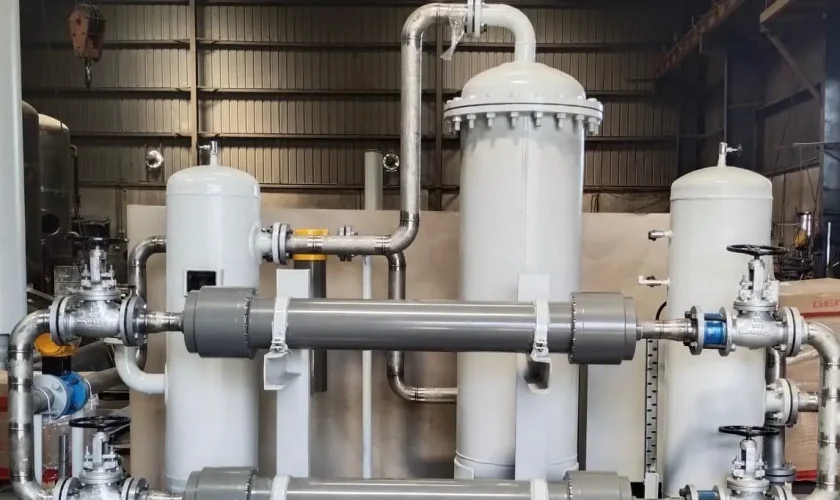
PSA nitrogen generators use carbon molecular sieve (CMS) to adsorb oxygen and trace gases, producing high-purity nitrogen through alternating adsorption beds.

In 2025, advancements in CMS materials, faster cycling valves, and intelligent PLC controls make PSA systems the most versatile option—delivering 95% to 99.999% purity and flow rates from tens to thousands of Nm³/h.

Typical applications include:

  • Food packaging: 99–99.9% purity
  • Pharmaceuticals: 99.5–99.999% purity
  • Electronics and laser cutting: ultra-high purity nitrogen

PSA skids are modular, scalable, and maintain stable purity under varying demand—especially when paired with well-sized buffer storage tanks.

Membrane Separation

Hollow-fiber membrane systems separate gases based on permeation speed: oxygen molecules pass through the membrane faster, while nitrogen remains in the main stream.

Membranes excel at 95–99.5% purity levels with steady, moderate-to-high flows. They offer:

  • Quick startup and shutdown
  • Compact design with minimal maintenance
  • No moving parts for high reliability

These systems are ideal for oil and gas inerting, marine operations, tire inflation, and food preservation where 98–99% purity suffices. However, as purity targets climb above ~99%, energy consumption increases sharply, making membranes less efficient for ultra-high purity needs.

Cryogenic (Small Onsite ASU)

Compact cryogenic air separation units (ASUs) liquefy and distill air to produce high-flow nitrogen at 99.999% purity, with the added flexibility of supplying liquid nitrogen.

Although cryogenic systems involve higher upfront costs and greater complexity, they deliver significant long-term savings for large-scale users or those requiring liquid backup. Modern packaged ASUs are increasingly competitive against bulk nitrogen deliveries, especially for continuous, high-demand operations.

Hybrid and Packaged Solutions

Some facilities now deploy hybrid nitrogen systems—using membranes to meet base-load demand and PSA polishing for higher purity peaks. Others integrate high-pressure boosters for specialized applications like laser cutting or pharmaceutical manufacturing.

By 2025, turnkey nitrogen generation packages often include:

  • Air compressors and dryers
  • Filtration and gas storage
  • Centralized PLC control and monitoring

These integrated systems streamline installation, reduce maintenance coordination, and provide a single-vendor solution for complete reliability.

For expert guidance on selecting the right nitrogen generator for your application, visit https://pneutech.com/ — your trusted partner in precision gas generation, compressed air solutions, and industrial efficiency.

Selection criteria based on industry requirements

Choosing a nitrogen generator starts with how the plant uses nitrogen, purity, flow, pressure, and risk profile vary widely.

  • Food & Beverage (MAP, blanketing): Typically 99–99.9% purity, oil‑free air, hygienic design, HACCP alignment, and oxygen analyzers with data logging. PSA is common: membranes work for lower purity or inerting.
  • Pharmaceuticals & Biotech: 99.5–99.999% purity, validated performance, material traceability, and monitored critical parameters. Look for GMP-friendly documentation, alarms, and electronic records (e.g., audit trails) to support QA.
  • Electronics/SMT & Additive Manufacturing: Low oxygen ppm (down to 10 ppm), very dry gas (low dew point), ESD-safe materials, and stable pressure. PSA with polishing and high-precision analyzers is typical.
  • Metal Fabrication & Laser Cutting: High flow and pressure (often 30–40 bar) at 99.95%+ for clean cuts. Systems may integrate boosters, high-pressure storage, and fast-recovery controls to handle surge demand.
  • Chemicals, Oil & Gas: Inerting and purging at 95–99.9% purity, often outdoors or offshore. Membranes are attractive for robustness and footprint: PSA used when higher purity is required.
  • Laboratories & R&D: Lower flows with high purity and quiet operation: compact PSA or membrane cabinets with built-in compressors are common.

Key parameters to define before comparing models:

  • Purity: Expressed as % N2 or oxygen ppm: higher purity reduces available flow and raises energy use.
  • Flow: Peak, average, and turndown needs in Nm³/h or SCFH: include surge factors.
  • Pressure: Delivery and storage pressures: consider boosters for cutting or long distribution runs.
  • Air Quality: Pretreatment to ISO 8573-1 class suitable for the generator and end use: oil-free air may be mandated.
  • Environment: Ambient temperature, dust/salt exposure, and indoor vs. outdoor installation.
  • Compliance: Industry standards (e.g., FDA/USP expectations, HACCP, ATEX/HAZLOC where applicable).

Efficiency factors influencing generator performance

Operating cost is largely electricity. The following elements move the needle on kWh per unit of nitrogen produced:

  • Specific Energy Consumption (SEC): Compare vendors in kWh/Nm³ or kWh/100 SCF at the same purity and pressure. Small purity bumps can add significant energy.
  • Compressor Strategy: Variable speed drive (VSD) compressors and correctly sized dryers/filters prevent overcompression and wasted purge. Oil-free vs. oil-injected choices affect maintenance and risk of contamination.
  • Pressure Drop and Piping: Poor layouts force higher compressor setpoints. Right-size headers, minimize bends, and keep filters clean to maintain low ΔP.
  • Purge and Cycle Optimization (PSA): Modern controllers use oxygen feedback and adaptive timing to reduce purge losses during low demand.
  • Membrane Operating Temperature: Membranes deliver more flow when warm but can drift in purity: stable conditions and good pretreatment preserve performance.
  • Air Treatment and Dew Point: Desiccant dryers deliver low dew points essential for high purities: heat-of-compression or heat-regenerated designs can lower energy vs. traditional heated purge.
  • Turndown and Standby Modes: Smart systems scale air production with demand or enter eco-standby without purity decay.

A quick rule: match generator capacity to real load profiles, not just nameplate peak. Right-sizing plus controls often saves double-digit energy percentages.

Cost considerations driving equipment decisions

Budgeting should consider the full picture, capital, installation, and years of operating expense.

  • CAPEX: Generator skid(s), compressors, dryers, filtration, analyzers, storage, boosters, and installation (foundations, electrical, ventilation). Cryogenic packages have higher CAPEX but can be economical at very large scales.
  • OPEX: Electricity dominates. Add filter elements, CMS replacement (8–15 years typical), membrane bundles (5–10 years), compressor service, and analyzer calibrations. Plan for spare parts kits to reduce downtime.
  • Cost of Nitrogen vs. Delivered Supply: Onsite generation commonly lands in the range of low cents per Nm³ (or per 100 SCF) depending on power rates and purity, while bulk liquid pricing swings with market and logistics. Many plants see payback in 1–3 years, but verify with a site-specific model that includes your kWh cost and duty cycle.
  • Redundancy and Risk: N+1 beds, dual compressors, and backup liquid cylinders add cost but protect high-value production lines. Quantify the cost of downtime to justify resilience.
  • Space and Infrastructure: Footprint, noise, heat rejection, and ventilation can add hidden cost. Outdoor-rated enclosures may simplify indoor space constraints.
  • Financing Options: Purchase, lease, or performance contracts tied to guaranteed purity/flow. In some regions, energy incentives support high-efficiency compressors and heat recovery.

A simple heuristic: if annual nitrogen spend on delivered gas is high and demand is steady, onsite generation often wins on total cost within a few budget cycles.

Importance of system scalability for future growth

Demand rarely stays flat. A smart 2025 design anticipates tomorrow’s flows, purities, and shifts in product mix.

  • Modular Skids: Choose PSA frames that accept additional adsorber beds or parallel membrane banks for stepwise expansion.
  • Storage Strategy: Buffer tanks and high-pressure cylinders smooth peaks so base equipment can be sized closer to average load.
  • Purity/Flow Flexibility: Ensure controls allow quick setpoint changes: higher purity reduces flow, so plan capacity headroom if purities may rise.
  • Upgradable Utilities: Leave electrical, cooling, and plinth space for extra compressors or boosters.
  • Digital Roadmap: Remote monitoring, trend data, and firmware updates make scaling and remote support faster and safer.

Designing with 20–30% future capacity in mind often avoids costly rework and production disruption later.

Maintenance and reliability as purchasing priorities

Reliability protects product quality and schedules. In evaluation, they should probe beyond a brochure’s uptime claims.

  • Air Quality First: Most issues trace to inadequate pretreatment. Specify filtration stages (particulate, coalescing, carbon as needed) and a dryer that reliably meets dew point targets under worst-case humidity.
  • Service Intervals and Access: Skids with front-facing filters, quick-release valves, and clearances reduce service time. Ask for a maintenance matrix with parts lists and typical hours.
  • Consumables and Media Life: CMS life is commonly 8–15 years with clean, dry air: membranes 5–10 years. Confirm replacement cost and changeout procedure.
  • Instrumentation: Redundant oxygen analyzers on critical lines, pressure and dew point transmitters, and event logging help catch drift before it hits product.
  • Warranties and SLAs: Look for performance guarantees (purity, flow, pressure) and response times. Local service coverage and stocked spares matter more than glossy specs.
  • Redundancy and Bypass: N+1 beds, dual compressors, and hard-piped bypasses enable maintenance without halting production.

A brief commissioning plan, air audits, leak checks, analyzer calibration, and operator training, often pays for itself within weeks.

read more
1 2
Page 2 of 2